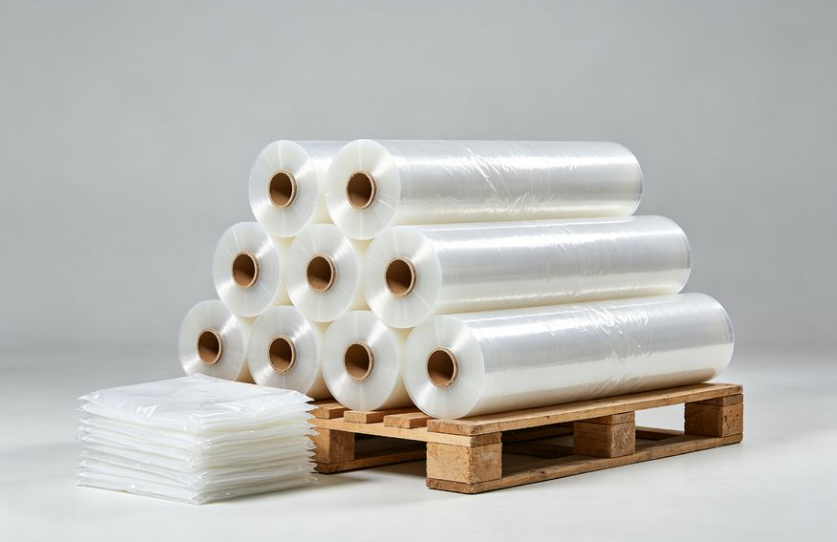
White film and bags are everywhere: shopping bags, T-shirt bags, packaging film, courier bags and composite film. The buyer’s eye is unforgiving — “white” that is gray, yellowed or translucent fails on the shelf. The difference between an acceptable white and a bright, opaque white is the titanium dioxide (TiO₂) loading and dispersion of the masterbatch.
We have manufactured white masterbatch for film processors since 2002. This guide covers our 50% and 70% TiO₂ film grades — with the actual specifications and the trade-offs behind them.
How white masterbatch works
Titanium dioxide is the strongest white pigment available, with extremely high hiding power and a high refractive index. In a masterbatch it is concentrated (typically 40%–80%) in a carrier resin, then diluted by the processor’s base resin at the recommended dosage. Three properties matter:
- TiO₂ loading: higher loading reaches target whiteness at lower dosage.
- Dispersion: undispersed TiO₂ particles become grit, fish eyes or print defects.
- Carrier match: the carrier must flow like the base resin to avoid haze and surface defects.
Our film-grade white masterbatch range
| Grade | TiO₂ content | Carrier | MFI (g/10min) | Dosage | Typical applications |
|---|---|---|---|---|---|
| 70% blown-film white masterbatch | 70% | PE | 38 | 0.5%–2% | Trash bags, shopping bags, T-shirt bags, packaging bags, woven bags, dry composite film, coating film, packaging film |
| Shopping-bag white masterbatch | 50% | LDPE | 38 | 2%–5% | White plastic bags, dry composite film, cast film, black-white film, packaging film (food-grade) |
Both grades are compatible with PE (HDPE, LDPE, LLDPE) and PP.
The 70% grade: bright white at low dosage
The 70% blown-film white masterbatch is our high-performance film grade, using imported titanium dioxide with a PE carrier. Its design goals:
- High pigment concentration — 0.5%–2% dosage reaches a bright, opaque white, keeping cost per bag low.
- Excellent dispersion — no grit, no fish eyes, stable filter pressure over long runs.
- Good compatibility with PE film resins, and dust-free handling for safe, clean processing.
This is the grade to specify when film thickness is tight, printing follows, or the buyer compares whiteness side by side.
The 50% grade: food-grade white for bags
The shopping-bag white masterbatch (50% TiO₂, LDPE carrier, MFI 38, dosage 2%–5%) is formulated for white plastic bags, dry composite film, cast film, black-white film and general packaging film. Its specifications reflect food packaging reality:
- TiO₂-only formulation — the colorant component is titanium dioxide with no other pigment components, which is why this grade carries food-grade positioning.
- Fine particle, no grit — printing and lamination surfaces stay clean.
- Gloss and toughness — the film remains processable and strong at the recommended dosage.
- Cost reduction — good dispersion at controlled dosage lowers pigment cost per finished bag.
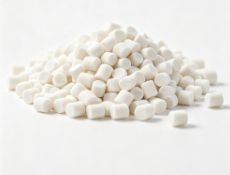
Dosage and processing rules for white film
- Dosage: 70% grade 0.5%–2%; 50% grade 2%–5%. Adjust for whiteness target, film thickness and base resin.
- Mixing: 3–5 minutes until evenly distributed.
- Storage: sealed, moisture-proof; moisture causes bubbles and splay.
- Inspection: check for yellowing, gray tone, grit and print surface defects.
Choosing between 50% and 70%
| Your priority | Recommended grade |
|---|---|
| Lowest dosage, brightest white, thin film | 70% blown-film grade (0.5%–2%) |
| Food-grade white bags at controlled cost | 50% shopping-bag grade (2%–5%) |
| Printed film, lamination or coating | 70% grade for surface cleanliness; verify with a print test |
| Black-white (ABA) film | 50% grade on the white layer; see our black film guide for the black layer |
Frequently asked questions
Why is my white film slightly gray or yellow?
Gray tone usually means insufficient TiO₂ dosage or base-resin discoloration; yellowing is often heat or UV exposure. Increase dosage within range, check processing temperature, or use a higher-loading grade.
Is white masterbatch food-safe?
Food-grade positioning depends on the full formulation. Our 50% shopping-bag grade is TiO₂-only, which is why it carries food-grade positioning; always request compliance documentation (FDA-related testing, EU food-contact) for your specific application.
How much white masterbatch for white shopping bags?
Typically 2%–5% of the 50% grade or 0.5%–2% of the 70% grade, adjusted for bag thickness and whiteness target.
Does high TiO₂ loading affect film strength?
At recommended dosage, no. The risk is over-dosing or poor dispersion; follow the grade’s dosage window and trial on your line.
About Caytten
Caytten (Shijiazhuang Caiteng Technology Co., Ltd.) has manufactured white masterbatch since 2002, with 12 automated twin-screw production lines and an annual capacity exceeding 50,000 tons. Our 50%–70% TiO₂ film grades serve shopping bag, packaging film and composite film producers worldwide, with raw materials passing SGS, RoHS and FDA testing.
Making white film or bags? Tell us the product, gauge and whiteness target — we will recommend the TiO₂ loading and send samples. Explore white masterbatch or contact our team. WhatsApp/Tel: +86 13903216617.